Curriculum · Contact & Upheaval · 22 min
Arab Traders and the Coming of Islam
Caravans, ivory, firearms and a new faith: how coastal Muslims reshaped Buganda's court and connected it to the Indian Ocean world.
Draft lesson: historical review pending.
The first Muslims to reach the interior of present-day Uganda were not conquerors but traders. From the 1840s, caravans organised from Zanzibar and the East African coast travelled through Tabora and Karagwe to the courts of the Great Lakes, carrying cloth, beads, metal goods, firearms and salt. They came for ivory, hides, rhinoceros horn and, increasingly, slaves. The people Europeans called 'Arabs' were a mixed group of Swahili-speaking coastal Muslims, many of them African, Arab and Comorian in origin. Their religion, language and commercial networks reshaped the region.
Buganda was the most important market. The first recorded visitor is usually named as Ahmed bin Ibrahim, who was received by Kabaka Suna II in the 1840s; the exact date is disputed, with 1844 often given. Suna and his successor Mutesa I (r. c. 1856–1884) welcomed the traders because they brought guns, cloth and new goods, and because long-distance trade strengthened the court against rival chiefs. By the 1860s caravans were a regular feature of Buganda's political life.
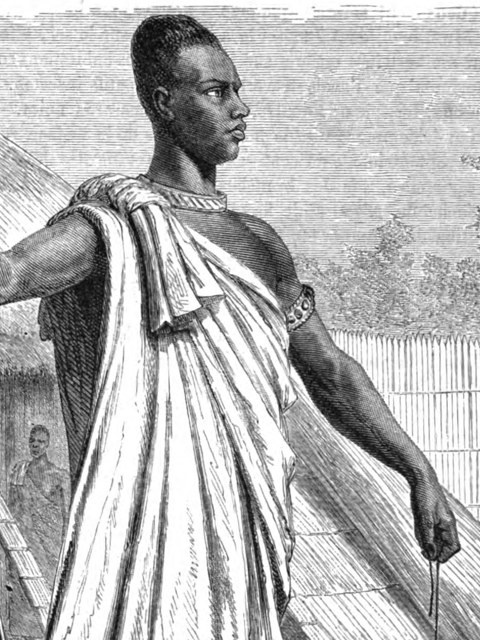
Islam spread through the court rather than through a missionary campaign. Mutesa I adopted Muslim dress and manners, learned to read Arabic and Swahili, observed Ramadan for years, and allowed mosques to be built. He refused circumcision, which suggests that his adherence was political as well as religious. Muslim teachers and scribes became advisers; Arabic script was used to write Luganda; and a party of Muslim chiefs emerged at court. The period from about 1862 to 1875 is often called the 'golden age of Islam' in Buganda.
The new faith was one element in a wider transformation. Coastal trade introduced new crops, square houses, woven cloth, written literacy and Swahili as a language of commerce. It also intensified slavery and ivory hunting, increased the demand for firearms, and tied Buganda's court to the Indian Ocean economy. Rival chiefs competed for access to guns and trade goods, and the Kabaka used both to reward supporters and punish rivals. The same process was under way in Bunyoro, where Khartoum-based traders arrived from the north as well as Zanzibar caravans from the south.
Islam's position became contested after Mutesa's death in 1884. Christian missionaries arrived in 1877 (Anglican CMS) and 1879 (Catholic White Fathers), and their converts competed with Muslims for influence at the court of Mwanga II. In 1888 the religious factions fought a series of wars that briefly drove Mwanga from the throne. The Muslims held power for a time, but the Christians, with British support, defeated them in 1892. Islam survived as a minority religion, concentrated in Buganda and parts of eastern Uganda, and later spread through trade and migration.
The Arab and Swahili presence is often reduced to a story about slavery, or to a prelude to European colonialism. Both framings miss the complexity. The traders were agents of a long-distance economy that predated European rule; they were also bearers of a world religion, a script and a cosmopolitan culture. Their arrival created new forms of literacy, dress and architecture, and new political divisions. The religious wars of the 1880s were not simply a conflict between 'traditional' and 'foreign' beliefs: they were struggles over power in a kingdom whose rulers had learned to use foreign ideas for their own ends.
The legacy is visible today. Islam is a significant minority faith in Uganda, with historic mosques, schools and communities; Luganda was first written in Arabic script; and Swahili remains a regional language. The story also carries a warning about how sources are made. Much of what we know about the early traders comes from their rivals and from European travellers, and the label 'Arab' flattens a diverse group of Africans, islanders and immigrants. Reading the evidence carefully means separating trade from conquest, and religious change from political strategy.
Review & sources
Draft: awaiting historical review
This account awaits independent historical review. Linked sources support only the claims identified below.
- White Fathers, Islam and Kiswahili in Nineteenth-Century Uganda
Asian and African Studies 13:2 (2004), pp. 198–213. Accessed 2026-11-05.
Supports: The coastal caravan trade, Islam's spread in Buganda, Mutesa I's patronage, the religious wars, and the later politics of Kiswahili; the arrival of the Anglican and Catholic missions and the competition that led to the religious wars.
Viera Pawliková-Vilhanová's study of Islam's spread in Buganda, the coastal caravan trade, Mutesa I's patronage, the religious wars, and the later politics of Kiswahili.
- Islam in Pre-Colonial Buganda
In Joseph Kasule, Islam in Uganda (James Currey/Boydell & Brewer, 2022), pp. 31–66. Accessed 2026-11-05.
Supports: Mutesa I's use of Islam as a centralising royal ideology, the partial character of Islamization, and the entanglement of religion with court politics.
Kasule's argument that Mutesa I used Islam as a centralising royal ideology and that Islamization was partial, contested and entangled with court politics.
- Islam in Uganda: Islamization through a Centralized State in Pre-Colonial Africa
Wiley (1974). Accessed 2026-11-05.
Supports: Islam in Buganda before 1884, the role of the caravan trade, and the limits of Mutesa's Islamization.
Arye Oded's foundational study of Islam in Buganda, the caravan trade, Mutesa I's court, and the limits of Islamization before 1884.
- How 'Golden age of Islam' rose and collapsed in Buganda
Daily Monitor (2016). Accessed 2026-11-05.
Supports: Ahmed bin Ibrahim's reception by Suna II, the disputed date of the first visit, and the 'golden age' of Islam.
The first recorded Arab visitor, Ahmed bin Ibrahim, the court of Suna II, Mutesa I's reception of coastal traders, and the 'golden age' of Islam.
Glossary
- Swahili
- A Bantu language of the East African coast and a lingua franca of trade, also used by coastal Muslim communities in the interior.
- Ivory trade
- The long-distance commerce in elephant tusks, which linked the Great Lakes to Zanzibar and the Indian Ocean market.
- Mutesa I
- Kabaka of Buganda (r. c. 1856–1884), who patronised coastal traders, adopted elements of Islam and used the caravan trade to strengthen the court.
- Ramadan
- The Islamic month of fasting, observed by Mutesa I for years according to contemporary accounts.
- Religious wars
- The conflicts of 1888–1892 between Muslim, Anglican and Catholic factions in Buganda for control of the kingdom.
Quiz
Question 1 of 5