Curriculum · Foundational Era · 24 min
Origins of the Bachwezi
Oral tradition, archaeology, and the historiographical debate over the Bachwezi and the so-called Kitara empire.
Draft lesson: historical review pending.
The Bachwezi are among the most enigmatic figures in the early history of the Great Lakes region. Oral traditions describe them as a dynasty of semi-divine rulers who could disappear and reappear, control rain, and communicate with spirits. The best-known names — Ndahura, Wamara and Mulindwa — survive in clan histories, shrine sites and ritual practice, especially in Bunyoro-Kitara and the western kingdoms. Ndahura is remembered as a conqueror and the first great ruler; Wamara as the last, associated with the cow Bihogo and the dynasty's collapse; Mugenyi with herds; and Kagoro with lightning and war. In Buganda the Bachwezi are remembered more as a distant predecessor era than as a ruling dynasty.
The tradition also gives them an empire. According to Bunyoro accounts, the Bachwezi founded Kitara, a realm said to have stretched from the Congo border to Buganda and south toward Rwanda. That picture was elaborated in the colonial era by the Hamitic hypothesis — the theory that African states must have been founded by a superior foreign race — and by later scholars who generalised the Alur kingdom's structure to the whole region. The result was a neat model of a centralised empire that the evidence does not clearly support.
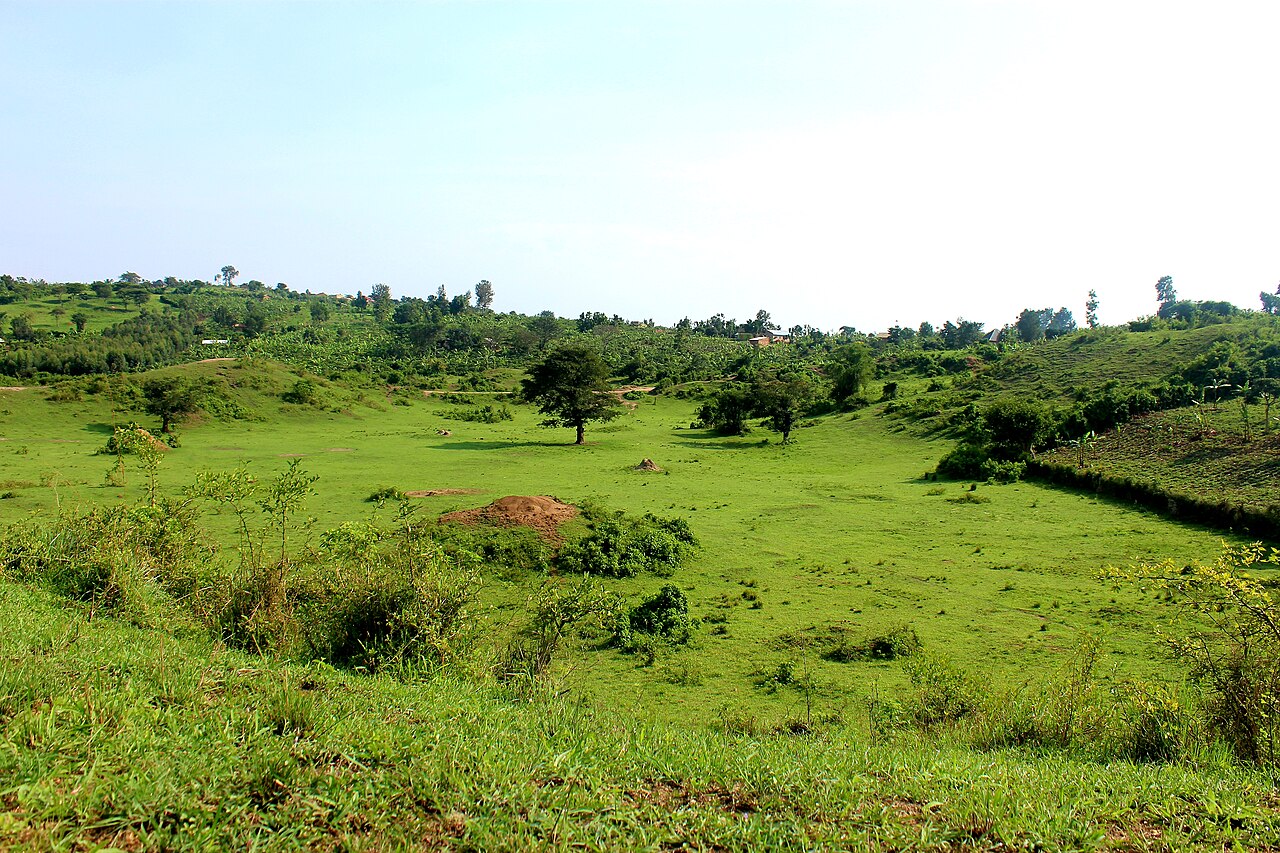
Archaeology tells a more limited story. Bigo bya Mugenyi preserves a system of earthworks and ditches dated in Uganda's heritage submission to the fourteenth to sixteenth centuries; Ntusi has man-made mounds, the Bwogero basin and pottery and bone deposits. The sites are not contemporary in a simple way: Ntusi's occupation runs from about the eleventh to the fifteenth century, while Bigo's earthworks are usually placed in the later part of that span, around 1275–1550. Ntusi was a cattle-and-grain settlement; Bigo's trenches imply organised labour. Neither has produced a palace or a royal tomb that can be tied to a named Bachwezi ruler, and neither establishes the borders of an empire.
The source problem is acute. The earliest written accounts are late nineteenth-century European travellers and missionaries, who recorded oral traditions already shaped by political competition; the fullest king lists were compiled in the early twentieth century by Apolo Kaggwa and others. Archaeology provides independent dates but not names. This lesson therefore separates three questions: what the traditions say, what the sites show, and what can be inferred about political organisation.
The historian M. S. M. Semakula Kiwanuka made the strongest case against the empire model. He argued that Bacwezi power was a loose western federation, not a centralised state; that its influence stopped at the Katonga for ecological reasons; that the Lwo left no cultural or linguistic residue in Buganda; and that claims of a vast Kitara dominion were produced by forcing oral traditions to yield information they do not contain. His book also argues that Kimera, the dynastic founder remembered after Kintu, came from the older western Kitala world rather than from the Babito kingdom on the Nile, and was not a Mubito at all.
The chronological picture is equally unsettled. Kiwanuka treats 'Kintu' as a period compressing several leaders rather than a single reign, notes pre-Kintu rulers with jawbone shrines, and counts thirty-four names in the standard king list where the wider canon counts thirty-six. His own tables place Kimera about half a century apart. These are not details to smooth over: they show how much of early Buganda's history rests on relative, not absolute, dates.
What remains is a real and important western interlacustrine power complex, remembered across Bunyoro, Buganda, Toro and Ankole, whose scale and organisation are still debated. The Bachwezi are best approached as a tradition about power and legitimacy — one that archaeology can illuminate but cannot verify as a dynasty of miracle-workers or as the rulers of a single empire.
Review & sources
Draft: awaiting historical review
This account awaits independent historical review. Linked sources support only the claims identified below.
- Bigo bya Mugyenyi: archaeological earthworks
Uganda Department of Antiquities and Museums, published by the World Heritage Centre. Accessed 2026-10-09.
Supports: Bigo earthworks, chronology, and the reported oral association with the Bachwezi.
Uganda's tentative-list submission, not an independent UNESCO verification.
- Ntusi: man-made mounds and basin
Uganda Department of Antiquities and Museums, published by the World Heritage Centre. Accessed 2026-10-09.
Supports: Ntusi deposits and its reported oral association with the Bachwezi.
Uganda's tentative-list submission, not an independent UNESCO verification.
- The Antecedents of the Interlacustrine Kingdoms
Journal of African History. Accessed 2026-11-05.
Supports: Ntusi's eleventh–fifteenth-century occupation, the later dating of Bigo and Mubende, and the absence of archaeological support for a Cwezi state.
Peter Robertshaw's archaeological reassessment: Ntusi occupied c. 11th–15th centuries, Bigo and Mubende in the later part of that span, no archaeological support for a Cwezi state, and small competing polities before the kingdoms.
- A History of Buganda from the Foundation of the Kingdom to 1900
Longman / Africana Publishing (1972). Accessed 2026-11-05.
Supports: The critique of the Kitara empire and Hamitic/Lwo models; the argument that Kimera was not a Mubito; Kintu as a period; the thirty-four-name king list and disputed chronology.
M. S. M. Semakula Kiwanuka's monograph. Used for the critique of the 'Kitara empire' and Hamitic/Lwo models, the argument that Kimera was not a Mubito and founded a new dynasty, the treatment of Kintu as a period, the Ssese dynastic union, and the 1900 Agreement signatories. Its own chronological tables disagree by about fifty years.
Glossary
- Bachwezi
- A semi-mythical ruling dynasty of the western interlacustrine region, associated with Kitara and said to possess supernatural powers.
- Kitara
- A realm traditionally credited to the Bachwezi; historians dispute whether it was a centralised empire or a looser western federation.
- Bigo bya Mugenyi
- A site in present-day Sembabule with earthworks and ditches dated to the fourteenth–sixteenth centuries and associated in oral tradition with the Bachwezi.
- Ntusi
- A Later Iron Age site with man-made mounds, the Bwogero basin, and pottery and bone deposits, occupied from about the eleventh to the fifteenth century.
- Hamitic hypothesis
- A colonial-era theory that African states were founded by a superior foreign race; it shaped early interpretations of the Bachwezi and Kitara.
Quiz
Question 1 of 5