Curriculum · Classical Kingdoms · 20 min
The Salt Economy of Kibiro
How women turned saline earth and hot springs into one of Bunyoro's most valuable exports — and why the industry survived for centuries.
Draft lesson: historical review pending.
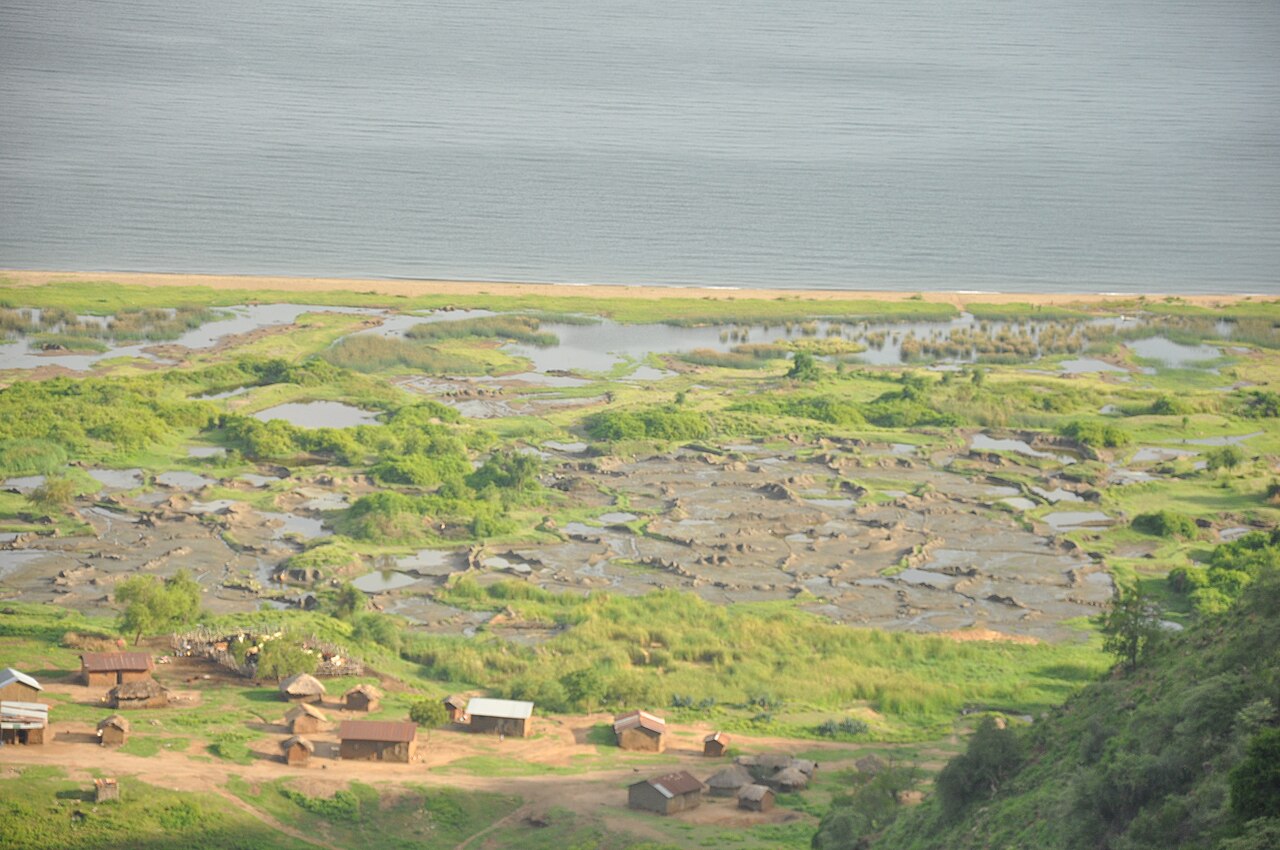
Kibiro sits on the eastern shore of Lake Albert, in Hoima District, where a steep escarpment meets the rift valley floor. The village is not obvious from the water: salt gardens, hot springs, houses and archaeological deposits are packed into about ten hectares. Yet for centuries this small place produced one of the most valuable commodities in the interlacustrine world. Salt from Kibiro travelled to markets in Bunyoro, Buganda, the Congo and beyond, and the industry helped make the Bunyoro-Kitara kingdom wealthy.
The salt is not mined from rock. It comes from saline earth and brine associated with hot springs at the base of the escarpment. Producers spread loose soil across the salt gardens and let it absorb salty moisture drawn up by capillary action; the sun dries it, and the enriched earth is scraped up, leached with water, and the brine boiled in pots until crystals form. The work is repeated in cycles, and spent earth is returned to the gardens. The method sounds simple; in practice it requires exact knowledge of soils, weather, fuel and timing.
The work is women's work. At Kibiro, salt gardens were owned and inherited through the female line, passing from mother to daughter, aunt or mother-in-law. Men were barred from processing by custom and taboo. That matrilineal system is unusual among salt sites in the region and has been central to the village's nomination for UNESCO World Heritage listing. Women's control of the gardens gave them economic standing and a public role that colonial and missionary accounts often overlooked.
Archaeology shows how old the industry is. Graham Connah's excavations in 1989 and 1990 found pottery and other refuse buried up to four metres deep, the accumulation of centuries of occupation. The earliest deposits have been dated to roughly 700–900 years ago, and the pottery styles suggest links with the upper Nile and the west. Salt production was probably an important part of the Bunyoro economy from an early date, though the kingdom's origins cannot be reduced to salt alone.
Salt entered several economies at once. It was a necessity for cooking and preserving food, a gift and ritual substance used in royal installation and healing, and a trade good exchanged for fish, grain, iron, barkcloth, beads and livestock. Control of Kibiro was therefore a political prize. Bunyoro's rulers claimed tribute from the salt gardens, and competing powers tried to control the routes that carried salt east and south. The trade linked the Albertine Rift to the courts of Buganda and to longer-distance networks reaching the Indian Ocean coast.
Kibiro did not become a large town. Production was seasonal, labour-intensive and organised through household and clan rights rather than factories. Its wealth lay in a specialised product that almost everyone needed. That specialisation made the community vulnerable to drought, cattle disease, war and the shifting demands of colonial trade, but it also gave Kibiro a continuity that many larger political centres lacked.
Today salt is still made at Kibiro, though the number of producers has fallen and lake levels, fuel costs and cheap imported salt threaten the trade. In 2025 Uganda placed the village on its UNESCO Tentative List, citing the living tradition, the archaeology and the matrilineal system. The site is a reminder that economic history is not only about kings and armies: it is also about the knowledge of women who turned earth, water and fire into a commodity that shaped a kingdom.
Review & sources
Draft: awaiting historical review
This account awaits independent historical review. Linked sources support only the claims identified below.
- Kibiro Salt Producing Village
Uganda Ministry of Tourism, Wildlife and Antiquities, published by the World Heritage Centre. Accessed 2026-10-09.
Supports: Kibiro's location, salt gardens, hot springs, women's role, matrilineal tenure, archaeological deposits and UNESCO tentative-list status.
Uganda's 2025 tentative-list submission. Coordinates identify a reference point with minute precision.
- Salt-production at Kibiro
Azania: Archaeological Research in Africa 25 (1990), pp. 27–39. Accessed 2026-11-05.
Supports: The leaching and boiling process, women's monopoly of production, and archaeological evidence for roughly 700–800 years of salt working.
Graham Connah, Ephraim Kamuhangire and Andrew Piper's excavation and ethnographic study of Kibiro's salt gardens, women's production, and evidence for 700–800 years of salt working.
- The salt of Bunyoro: seeking the origins of an African Kingdom
Antiquity 65:248 (1991), pp. 479–494. Accessed 2026-11-05.
Supports: The importance of Kibiro salt to Bunyoro's early economy and state formation.
Connah's argument that Kibiro's salt industry was an important part of Bunyoro's early economy and state formation.
Glossary
- Kibiro
- A salt-producing village on the eastern shore of Lake Albert in Hoima District, worked for roughly 700–900 years.
- Salt garden
- A prepared patch of saline soil at Kibiro where salty moisture is drawn to the surface and dried before leaching.
- Leaching
- The process of washing salt out of enriched earth with water to produce brine for boiling.
- Matrilineal inheritance
- Inheritance through the female line; at Kibiro salt gardens passed from mother to daughter, aunt or mother-in-law.
- Bunyoro-Kitara
- The western kingdom whose rulers drew revenue and ritual prestige from Kibiro's salt industry.
Quiz
Question 1 of 5