Curriculum · Foundational Era · 18 min
Daily Life at Ntusi
Cattle, grain, iron and trade at a Later Iron Age chiefdom in the Bwera grasslands.
Draft lesson: historical review pending.
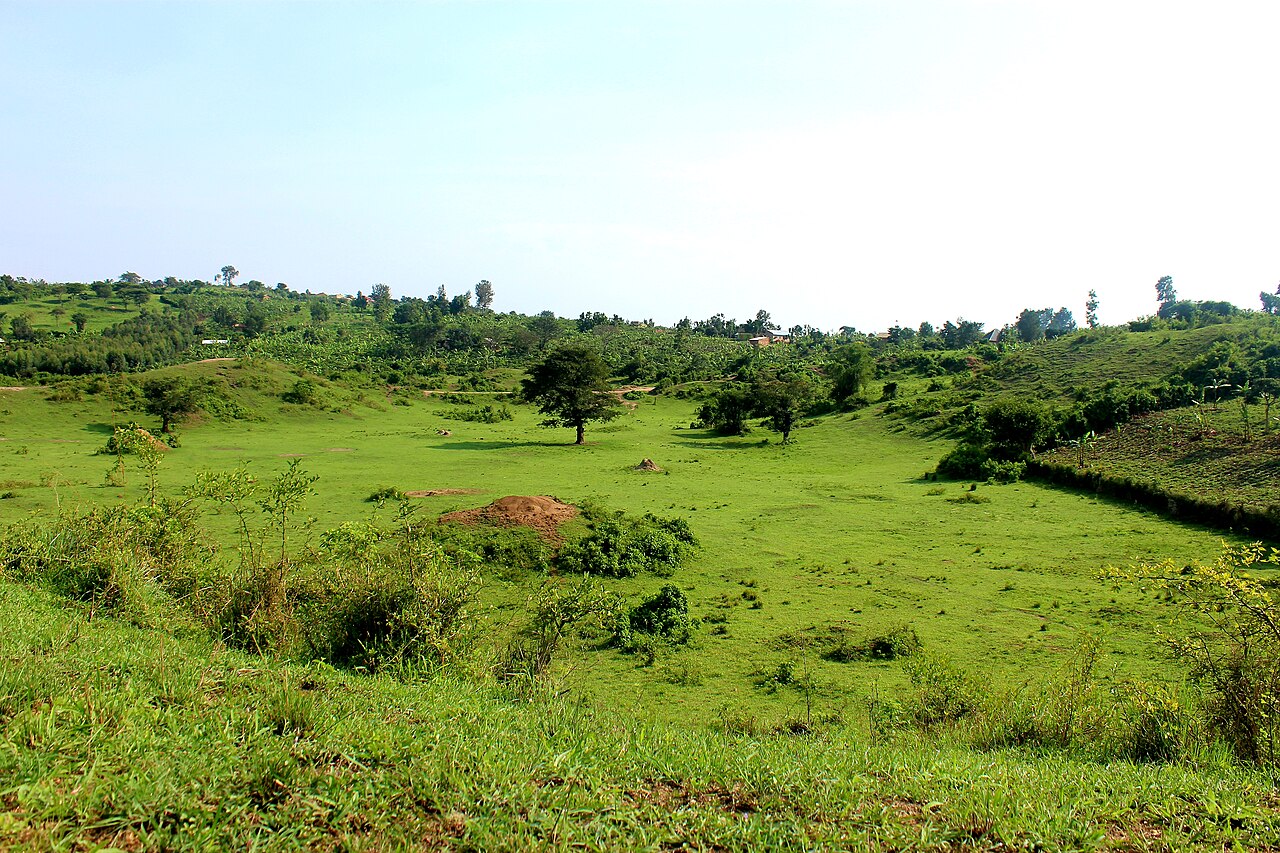
Ntusi lies in Lwemiyaga County, Sembabule District, in the rolling grasslands of western Uganda. It is a Later Iron Age site occupied from roughly the eleventh to the fifteenth century. The village covers about a square kilometre and is surrounded by a wide expanse of open country; the nearest comparable earthworks at Bigo bya Mugenyi lie about sixteen kilometres away. Two large man-made mounds — known locally as the male and female mounds — and a shallow basin called the Bwogero are the site's most conspicuous features.
The mounds are not natural hills. Excavations found deposits up to four metres deep, built up from household refuse, ash, bone and pottery over centuries. The female mound appears to have been a long-used dump; the male mound contained similar debris plus ornamental goods, including carved ivory, ostrich-egg-shell beads, glass beads and copper. The deposits are a rare archive of everyday life: broken grindstones, carbonised sorghum and millet, animal bones, iron knives and potsherds.
Cattle dominated the economy. At Ntusi, cattle make up as much as ninety per cent of the animal bones recovered, and many were slaughtered young — a pattern consistent with large herds managed for milk and prestige as well as meat. But this was not a purely pastoral society. Grinding stones, grain-harvesting knives and storage pits show that sorghum and finger millet were grown and processed, and residue analysis suggests that a substantial share of pots were used for preparing grain. Cattle and crops were combined, not opposed.
The site also reveals craft production and long-distance contact. Ironworking debris and iron knives point to local smelting and forging; pottery was made and used in quantity. Ivory, ostrich-egg-shell beads, glass beads and copper reached Ntusi from far away, including the Indian Ocean coast. These imports were probably controlled by local elites and used to mark status. The presence of such goods, alongside the labour needed to build and maintain the mounds, suggests a society with ranked families and a recognised centre.
Politically, Ntusi looks like a chiefdom rather than a centralised state. Survey found a series of smaller sites around it, many of them cattle enclosures, extending up to about fifteen kilometres from the centre. That pattern suggests a central settlement exercising some authority over outlying herding communities, but not a bureaucracy or a standing army. Competition over pasture and fertile land may have driven both the growth and the eventual fragility of the settlement.
Ntusi was abandoned by the fifteenth century, while Bigo's earthworks were still in use. The two sites are linked in oral tradition to the Bachwezi, but archaeology dates Ntusi about two centuries earlier than Bigo and does not confirm a single dynasty moving from one capital to the other. What Ntusi does show is the material world behind the legends: cattle wealth, grain farming, iron, regional trade and a ranked society — the foundations on which the later interlacustrine kingdoms were built. Its value lies in what it says about ordinary people: meals, tools, herds and trade goods, not only rulers.
Review & sources
Draft: awaiting historical review
This account awaits independent historical review. Linked sources support only the claims identified below.
- Ntusi: man-made mounds and basin
Uganda Department of Antiquities and Museums, published by the World Heritage Centre. Accessed 2026-10-09.
Supports: The mounds, Bwogero basin, deposits, large pots and the site's Later Iron Age designation.
Uganda's tentative-list submission, not an independent UNESCO verification.
- Cattle, identity and genocide in the African Great Lakes region
Archaeology International 4 (2000). Accessed 2026-11-05.
Supports: Cattle-dominated faunal assemblage, grain processing, outlying cattle enclosures, and the chiefdom interpretation.
Andrew Reid's synthesis of Ntusi's faunal and settlement evidence: cattle-dominated but grain-using economy, outlying cattle enclosures, and a chiefdom rather than a centralised state.
- The Antecedents of the Interlacustrine Kingdoms
Journal of African History. Accessed 2026-11-05.
Supports: Ntusi's eleventh–fifteenth-century occupation and its relationship to Bigo and the later kingdoms.
Peter Robertshaw's archaeological reassessment: Ntusi occupied c. 11th–15th centuries, Bigo and Mubende in the later part of that span, no archaeological support for a Cwezi state, and small competing polities before the kingdoms.
Glossary
- Ntusi
- A Later Iron Age site in Sembabule District, occupied from about the eleventh to the fifteenth century.
- Bwogero
- The shallow basin at Ntusi, one of the site's principal earthworks.
- Later Iron Age
- The period after the Early Iron Age, associated in the Great Lakes with larger settlements, cattle wealth and early chiefdoms.
- Ntusi mounds
- Two large mounds built up from household refuse and ash over centuries of occupation.
- Cattle enclosures
- Outlying sites around Ntusi, interpreted as stock-keeping settlements under the centre's influence.
Quiz
Question 1 of 5