Personalities · Contact & Upheaval
Kabaka Mutesa I
Kabaka of Buganda (Mutesa I Mukabya Walugembe) · Buganda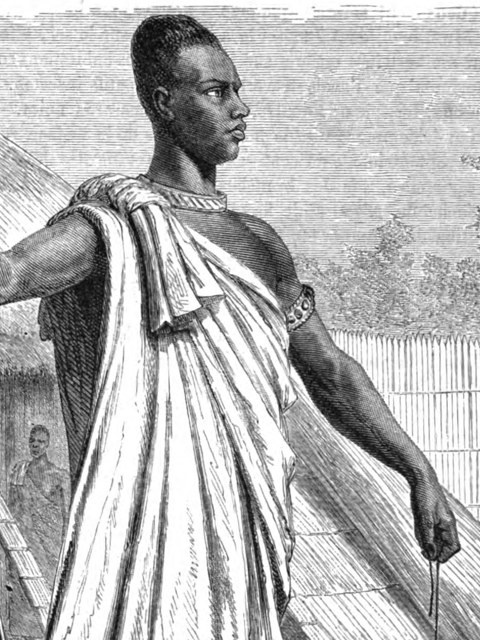
Portrait attribution is available in the asset credits.
Review & sources
Draft: awaiting historical review
This account awaits independent historical review. Linked sources support only the claims identified below.
Claim-specific sources have not yet been supplied for this account.
Kabaka Mutesa I Mukaabya Walugembe was enthroned around 1856 as the 30th Kabaka of Buganda following the death of his formidable father, Kabaka Suuna II. Entering power as a teenager amidst rival court factions, Mutesa displayed an extraordinary, calculating statecraft that centralized royal authority and transformed Buganda from a regional power into the dominant political empire of the Lake Victoria basin.
Mutesa was the first Kabaka to engage extensively with the wider world. He expanded trade caravans with coastal Swahili and Arab merchants who had begun arriving during his father's reign, eagerly adopting imported firearms, textiles, and literacy. For over a decade, Mutesa engaged deeply with Islamic theology, studying the Quran, observing Ramadan at court, and adopting Arab dress, while using imported muskets to dominate regional trade routes and lakeside naval expeditions.
In 1862, Mutesa welcomed the British explorers John Hanning Speke and James Augustus Grant to his royal palace at Banda, marking Buganda's first direct contact with Europeans. Recognizing the shifting global balance of power and seeking military allies against Egyptian expansion from the north, Mutesa famously hosted Henry Morton Stanley in 1875. He permitted Stanley to publish an open letter in London's Daily Telegraph inviting Christian missionaries to Buganda.
The letter triggered the arrival of the Anglican Church Missionary Society in 1877, quickly followed by the French Roman Catholic White Fathers (Pères Blancs) in 1879. Rather than converting fully to either faith, Mutesa adroitly played Protestant, Catholic, Muslim, and traditional Balubaale spirit priests against one another, preserving his supreme royal autonomy and preventing any single faction from dominating his court.
Under his rule, Buganda built an elaborate administrative bureaucracy, a massive canoe fleet on Lake Victoria, and royal roads linking the capital to outlying counties. Suffering from chronic illness in his later years, Mutesa died in October 1884 at his capital on Kasubi Hill. He was entombed within his grand thatched palace, Muzibu Azaala Mpanga, which became the founding shrine of the UNESCO-inscribed Kasubi Royal Tombs.
Mutesa I is remembered as the diplomatic architect of modern Buganda: a master statesman whose intellectual curiosity and political acumen navigated the perilous opening chapters of European imperial contact without sacrificing Buganda's territorial integrity.
Timeline
Dates and events are carried over from the supplied record and remain pending independent verification.
- c. 1838Born in the Buganda royal court
- 1856Ascended as Kabaka of Buganda
- 1875Received Henry Morton Stanley at his court
- 1877First Protestant missionaries arrived in Buganda
- 1879Catholic missionaries (White Fathers) arrived
- 1884Died and was buried at Kasubi