Personalities · Colonial Formation
Rwot Awich
Rwot of Payira, Acholi · Acholi (northern territories)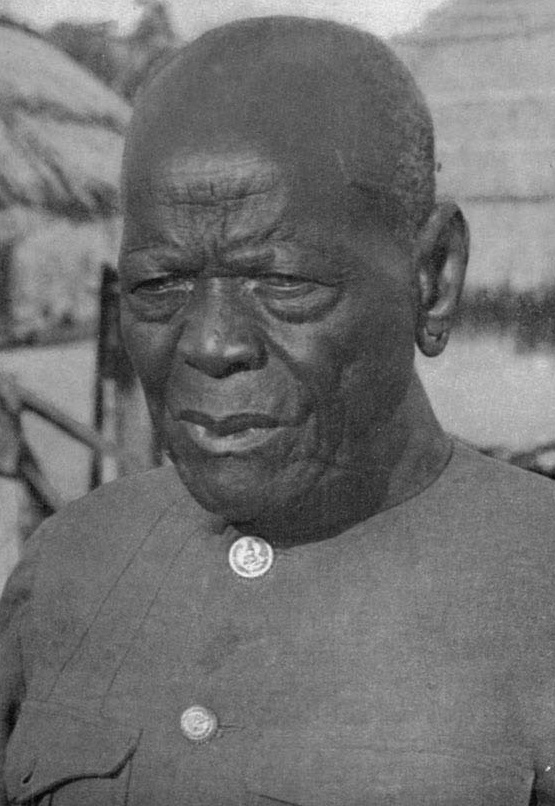
Portrait attribution is available in the asset credits.
Review & sources
Draft: awaiting historical review
This account awaits independent historical review. Linked sources support only the claims identified below.
- Chief Awich of Payira: a thorn in the flesh of colonialists
Daily Monitor. Accessed 2026-10-11.
Supports: Treaty refusal, sheltering of Kabalega's men, 1898–1902 war, Lamogi tunnels, alleged gas, Kololo imprisonment and naming lore.
Treaty refusal, sheltering of Kabalega's men, 1898–1902 war, Lamogi tunnels and alleged gas, Kololo imprisonment and naming lore.
- The fate of a transitional chief in colonial Acholiland: Iburaim Lutanyamoi Awich, 1850s–1946
AfricaBib (Canadian Journal of African Studies, 2021). Accessed 2026-10-11.
Supports: Scholarly frame: 1850s–1946 lifespan and transitional-chief interpretation (Otim 2021).
Scholarly frame and 1850s–1946 dating for Awich. Citation record only; the article sits behind its journal.
- How Acholi Chief's detention influenced the naming of Kololo hill
NTV Uganda. Accessed 2026-10-11.
Supports: 1911 arrest and sentencing; Kololo and Naguru naming tradition.
1911 arrest and sentencing; Kololo and Naguru naming tradition, presented as tradition rather than established fact.
Rwot Iburaim Lutanyamoi Awich was born in the mid-19th century into the royal lineage of Payira, the largest, most populous, and most politically influential chiefdom in Acholiland. Ascending the ancestral stool as Paramount Rwot around the 1880s upon the death of his father Rwot Rwot Camo, Awich was a ruler of extraordinary pride, judicial authority, and unbending devotion to Acholi sovereignty.
During the 1890s, as British colonial expeditions pushed north of the Victoria Nile, Awich steadfastly refused to submit to British imperial hegemony or collect foreign taxes. Demonstrating pan-African solidarity, Awich formed a secret alliance with Omukama Kabalega of Bunyoro, offering sanctuary, supplies, and Acholi riflemen to Kabalega's guerrilla resistance against the British.
When British forces under Major Delmé-Radcliffe occupied Acholiland in 1898 and established a colonial garrison at Nimule, Awich refused to recognize colonial borders or disarm his people. In 1901, the British launched a punitive military expedition against Payira, attacking Awich's stronghold at Mount Ogili. Captured after a fierce firefight, Awich was dragged south to Kampala and imprisoned on Kololo Hill for over a year.
However, British attempts to appoint collaborating puppet chiefs over Payira provoked widespread public rebellion and civil collapse. In 1902, the colonial government was forced to release Awich and reinstate him as Rwot of Payira. Rather than becoming pliant, Awich continued to oppose British tax registers and gun disarmament laws.
Between 1911 and 1912, when the British attempted forcibly to register and confiscate all firearms held by Acholi clans, Awich provided covert moral and logistical support to the famous Lamogi Rebellion. The British arrested Awich again in 1912, subjecting him to a formal colonial trial in Gulu and deposing him to internal exile in Nimule.
Allowed to return home in his final years, Rwot Awich lived with regal dignity in Payira until his death in 1946. Today, Rwot Awich is honored throughout northern Uganda as the primary architect of early anti-colonial resistance in Acholiland: an incorruptible traditional monarch who chose prison and exile over compromising the independence and honor of his people.
Timeline
Dates and events are carried over from the supplied record and remain pending independent verification.
- 1850sBorn, son of Rwot Camo of Payira
- 1887Succeeded after his father's murder
- 1892Refused the British cooperation treaties
- 1902Captured, then reinstated after revolt
- 1910Defied the gun-registration order
- 1911Withdrew to the Lamogi hills; rebellion
- 1912Captured and sentenced in Kampala
- 1946Died (reported; some accounts differ)