Personalities · Colonial Formation
Semei Kakungulu
General and founder of the Abayudaya · Bukedi (Eastern Province)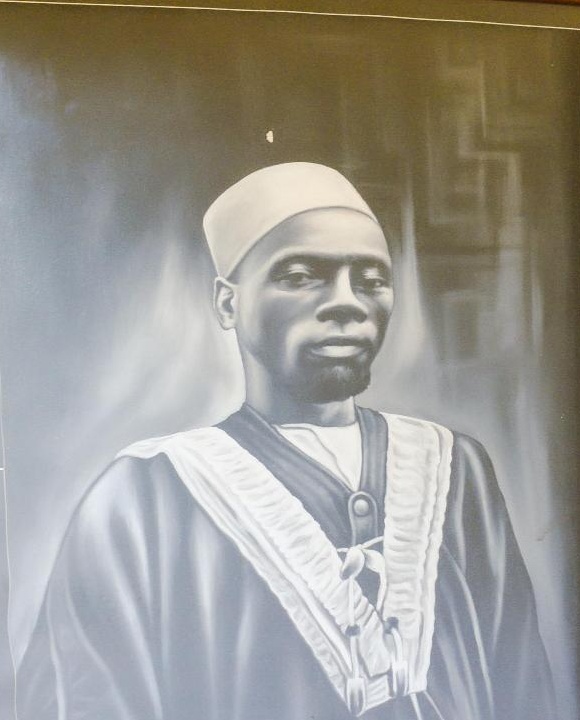
Portrait attribution is available in the asset credits.
Review & sources
Draft: awaiting historical review
This account awaits independent historical review. Linked sources support only the claims identified below.
- Semei Kakungulu, Jewish Warrior?
Kulanu. Accessed 2026-10-11.
Supports: Protestant conversion, Bukedi and Busoga campaigns, confinement to Mbale, Malakite turn, 1917 Gangama founding, 1922 rule book, mid-1920s encounters, death in 1928.
Military career under the British, 1917 Gangama founding, 1922 rule book, mid-1920s encounters with European Jews, death in 1928. Community-history account drawing on Twaddle.
- Uganda Virtual Jewish History Tour
Jewish Virtual Library. Accessed 2026-10-11.
Supports: 1884 district chief appointment, 1890s conquests, 1906 Lukiko presidency, 1913 resignation, burial at Gangama with about two thousand followers.
1884 district chief appointment, 1890s conquests, 1906 Lukiko presidency, 1913 resignation, Gangama burial with about two thousand followers.
Semei Lwakirenzi Kakungulu was born around 1856 in Kooki, migrating to Buganda as a young man where his natural tactical brilliance, physical presence, and marksmanship brought him to the direct attention of Kabaka Mwanga II. Rising through the ranks during the religious civil wars, Kakungulu converted to Anglican Christianity and emerged as one of the most fearsome and successful field commanders in the Great Lakes region.
During the turbulent crisis of 1897–1899, Kakungulu placed his formidable military talents at the disposal of British protectorate forces. Leading thousands of seasoned African riflemen through dense swamps and unfamiliar terrain, Kakungulu pursued the insurgent armies of Mwanga II and Omukama Kabalega across northern Uganda. On 9 April 1899, Kakungulu achieved a decisive victory at Kangai in Dokolo, capturing both monarchs and bringing the primary armed resistance to British rule to an end.
Rather than accepting a subordinate chieftaincy in Buganda, Kakungulu entered into an ambitious partnership with the British administration to pacify and administratively organize the previously unadministered eastern territories of the protectorate. Marching into Busoga, Teso, Bukedi, and the foothills of Mount Elgon between 1899 and 1904, Kakungulu established a sophisticated, disciplined network of fortified bomas linked by elevated all-weather roads and shaded by grand avenues of indigenous mvule trees.
Across eastern Uganda, Kakungulu transplanted the Buganda system of hierarchical administration, appointing his trusted lieutenants as county and sub-county chiefs, introducing cotton cultivation, and laying the municipal foundations of modern urban centers, most notably the city of Mbale on the slopes of Gangama Hill. Believing he had an agreement with early British commissioners, Kakungulu declared himself the sovereign 'Kabaka of Bukedi,' wearing custom royal regalia and holding court.
Alarmed by his growing autonomous power, the British colonial government reneged on their promises in 1913, formally stripping Kakungulu of his royal titles and reducing his jurisdiction to a local county chieftaincy. Deeply disillusioned by British duplicity and European ecclesiastical hypocrisy, Kakungulu broke completely with colonial Anglicanism.
In 1919, Kakungulu embarked on a profound spiritual transformation: through rigorous study of the Old Testament, he founded the Abayudaya community — an authentic African Jewish congregation centered at Gangama Hill in Mbale that adopted strict observance of the Torah, the Sabbath, and dietary laws. Semei Kakungulu passed away in November 1928, leaving a complex, monumental legacy: a military genius, the physical founder of eastern Uganda's road and urban network, and a spiritual visionary whose Abayudaya community thrives to this day.
Timeline
Dates and events are carried over from the supplied record and remain pending independent verification.
- 1869Born in Kooki
- 1884Appointed district chief in Buganda
- 1890sSubdued Bukedi and Busoga for the British
- 1899Took part in the capture of Kabalega and Mwanga
- 1906Became president of the Busoga Lukiko
- 1913Resigned his offices; turned to matters of faith
- 1917Founded the Abayudaya community at Gangama
- 1928Died at Mbale; buried at Gangama